




Plantar Fasciitis Home Stretches: 5 Moves to Ease Morning Heel Pain
The most effective home stretches for plantar fasciitis are the seated toe stretch, towel stretch, wall calf stretch, stair heel drop, and frozen-bottle foot roll. Do them two to three times a day, starting before your first step out of bed. Many people feel easier mornings within a few weeks, but full recovery can take months.
That stabbing heel pain the moment you step out of bed is the classic sign of plantar fasciitis. It is one of the most common causes of foot and ankle pain, and the good news is that simple stretching is a first-line treatment. If you’re reading this on a cold Ohio morning with your feet still on the mattress, the first stretch below can be done right there. Here is what to do, how long to hold each one, and when stretching alone isn’t enough.
Why Do Stretches Help Plantar Fasciitis?
Stretches help because the plantar fascia, a thick band of tissue running from your heel to your toes, gets overloaded and irritated where it attaches to the heel bone. Long shifts on hard floors or a sudden jump in walking or running are typical triggers, and the condition is a classic overuse injury.
Overnight your foot relaxes and the tissue tightens, so your first steps pull it taut all at once. Tight calf muscles make this worse because they connect to the heel through the Achilles tendon.
The evidence is solid. In a randomized trial of 101 people with long-standing heel pain, those who did a stretch aimed specifically at the plantar fascia had better first-step pain relief than those who only stretched the Achilles tendon (DiGiovanni et al., Journal of Bone and Joint Surgery, 2003). The 2023 clinical practice guideline from the American Physical Therapy Association’s orthopaedic section also gives plantar fascia and calf stretching its strongest (grade A) recommendation.
The 5 Best Plantar Fasciitis Home Stretches
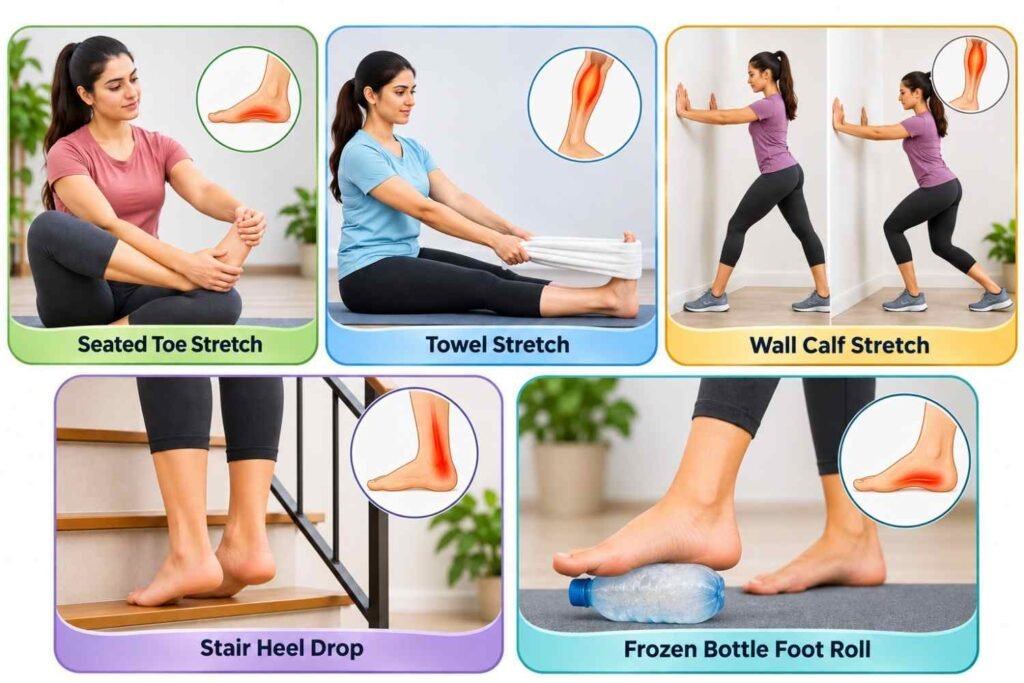
You only need a chair, a towel, a wall, a step and a water bottle. A mild to moderate pull is normal. Sharp pain is your cue to ease off.
1. Seated Toe Stretch (Do This Before You Get Out of Bed)
This is the most direct stretch for the plantar fascia, and the one that targets first-step pain.
- Sit up and cross the sore foot over your opposite knee.
- Hold your toes and gently pull them back toward your shin until you feel a stretch along the arch.
- Press a thumb along the arch. You should feel the band tighten.
Hold: 10 seconds. Repeat: 10 times. When: before your first step, then again midday and evening.
2. Towel Stretch
The towel stretch works both the arch and the calf at once, which makes it a good choice if you only have a minute.
- Sit with your leg straight out and loop a towel around the ball of your foot.
- Pull the towel toward you, keeping your knee straight, until you feel a stretch under the foot and up the calf.
Hold: 30 seconds. Repeat: 3 times per foot.
3. Wall Calf Stretch (Straight and Bent Knee)
A calf stretch for plantar fasciitis should hit both calf muscles. The straight-knee version targets the larger gastrocnemius, and the bent-knee version reaches the deeper soleus.
- Face a wall, hands at shoulder height, sore foot one stride back with toes pointing forward.
- Keep the back knee straight and heel down, then lean in. Hold.
- Now bend the back knee slightly, keeping the heel down, and hold again.
Hold: 30 seconds each version. Repeat: 3 times per leg.
4. Stair Heel Drop
- Holding a railing, stand on the bottom step with your heels hanging off the edge.
- Slowly lower one heel below the step until you feel a stretch in the calf and Achilles.
Hold: 20–30 seconds. Repeat: 2–3 times per leg. Always keep a hand on the rail.
5. Frozen Bottle Foot Roll
Rolling soothes tight tissue and the cold takes the edge off soreness. If you like the idea of cold therapy, see our guide to using ice and heat to manage pain from injuries.
- Sit with a frozen water bottle (or a tennis ball) under your arch.
- Roll slowly from heel to ball of the foot with gentle pressure.
Time: 1–2 minutes per foot, a few times a day.
How Long Should You Hold Plantar Fasciitis Stretches, and How Often?
Hold each stretch for 10 to 30 seconds, and do the full set two to three times a day. You will see two protocols online: 10-second holds repeated 10 times (the one used in the 2003 trial) and 30-second holds repeated 3 times. Both are reasonable. Pick one and stay consistent, because consistency matters more than the exact numbers.
Stretch | Hold | Repeat | Best time |
Seated toe stretch | 10 sec | 10× | Before first step |
Towel stretch | 30 sec | 3× | Morning and evening |
Wall calf stretch | 30 sec | 3× | Midday |
Stair heel drop | 20–30 sec | 2–3× | Midday or after work |
Frozen bottle roll | 1–2 min | 1–2× | After a long day on your feet |
How Long Do Plantar Fasciitis Stretches Take to Work?
Many people notice less first-step pain within two to four weeks, but give the routine at least eight to twelve weeks before judging it. Heel pain can take several months to settle fully, and it can return, so keep stretching a few minutes a day even after you feel better.
Stretching Mistakes That Slow Recovery
- Only stretching the calf: The calf matters, but the plantar fascia-specific stretch is the one with the strongest trial evidence.
- Stretching too hard: Overstretching can irritate the tissue. Aim for a firm pull, not pain.
- Skipping the morning stretch: Doing it before you stand protects that first loaded step.
- Quitting after two weeks: This is the most common reason people give up too early.
- Walking barefoot on hard floors: If you work long shifts on concrete, which is common in Ohio’s factories, warehouses and hospitals, supportive footwear helps every stretch work better.
When Stretching Isn’t Enough: See a Professional
See a physiotherapist or doctor if your heel pain hasn’t improved after six to eight weeks of consistent stretching. Get checked sooner if you have:
- Sudden severe pain, or a pop, after a fall or injury
- Swelling, redness, warmth or fever
- Numbness, tingling or burning in the foot
- Pain at night or at rest
- Diabetes with any foot pain
Not every sore heel is plantar fasciitis. A physiotherapist can confirm the cause and add treatments such as manual therapy or electrotherapy for injury recovery.
Frequently Asked Questions
What is the best stretch for plantar fasciitis?
No single stretch works for everyone, but the seated toe (plantar fascia) stretch, done before your first step in the morning, targets first-step pain most directly. Pair it with a calf stretch, because tight calves keep tension on the heel.
How long before plantar fasciitis stretches work?
Many people notice less morning pain in two to four weeks. Give a consistent routine eight to twelve weeks before judging it, since full recovery can take several months.
Can stretching make plantar fasciitis worse?
It can if you overstretch or use poor form. A firm pull is normal, but sharp or stabbing pain means stop and ease off. If stretching keeps increasing your pain, see a physiotherapist.
Can stretching alone cure plantar fasciitis?
Stretching resolves mild cases for many people. Moderate or stubborn cases usually need stretching combined with supportive footwear, activity changes and sometimes physiotherapy.
How many times a day should I do plantar fasciitis stretches?
Two to three times a day is the usual advice: once before you get out of bed, once midday and once in the evening. Also stretch before standing up after a long sit.
This article is educational and not a substitute for medical advice. Heel pain has several possible causes, so get an exam if symptoms persist.