





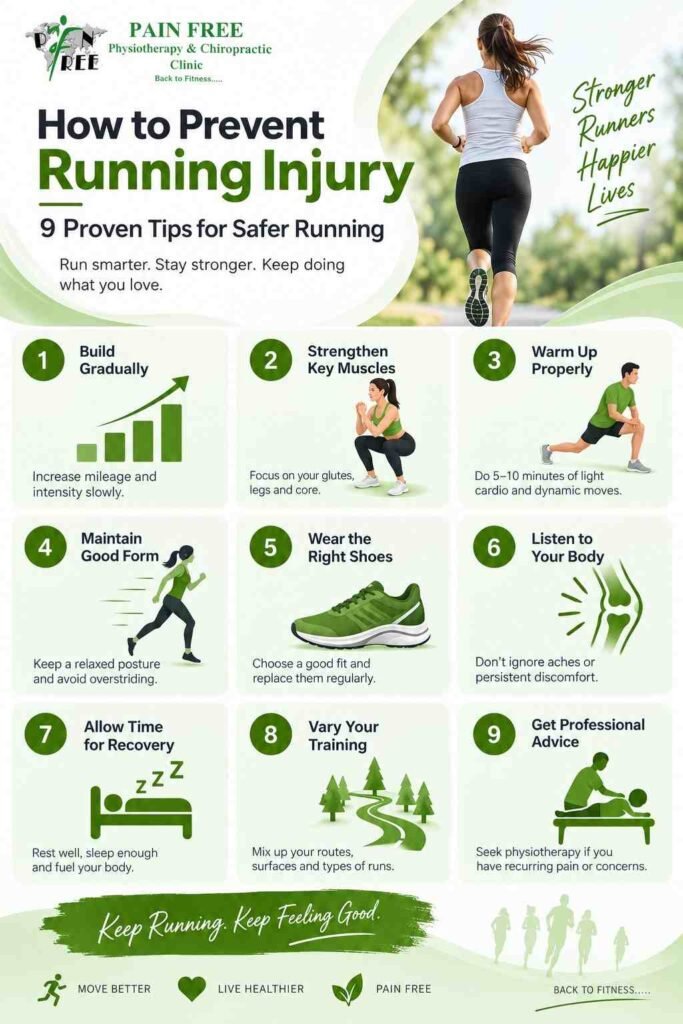
How to Prevent Running Injury: 9 Proven Tips for Safer Running
Most runners don’t get injured on the day it “happens.” A twinge in the knee shows up during week three of a mileage bump, gets ignored because the run still felt fine overall, and by week six it’s the reason you’re not running at all. Running itself isn’t the problem; how the training load builds up usually is.
Repeating the same movement thousands of times each week places real stress on your muscles, tendons, joints and bones. The good news: most running injuries can be reduced by managing training load, building strength, recovering properly, and responding to early warning signs the same principles behind any good sports injury rehabilitation program.
The goal isn’t to avoid every ache or overhaul how you run. It’s to give your body enough time and capacity to adapt to the demands you place on it.
Here are nine practical ways to reduce your injury risk and keep running consistently.
1. Increase Your Running Gradually
One of the most common mistakes runners make is doing too much too soon. Suddenly increasing mileage, adding speed workouts, running more hills or returning to your previous training level after a long break can cause muscle and tendon overload before tissues have adapted.
Rather than relying on a rigid mileage formula, look at your overall training load. Consider your distance, pace, frequency, hills and long-run duration.
For example, if you normally run three easy 3-mile sessions, jumping straight into a long 8-mile run plus intervals may be a much larger increase than your body is ready for.
Increase one major training variable at a time and give your body time to adapt.
2. Strengthen the Muscles That Support Your Running
Running is repetitive, so strength training helps your body tolerate repeated impact and maintain control as you tire.
Give particular attention to your:
- Glutes and hips
- Quadriceps and hamstrings
- Calf muscles
- Feet and ankles
- Core
Exercises such as squats, step-ups, calf raises, lunges, and controlled single-leg work can complement your running routine. A practical starting point for most runners is 2–3 sets of 8–12 reps per exercise, 1–2 times a week, on non-consecutive days if possible. Start with bodyweight or light resistance and add load gradually; the same “don’t do too much too soon” principle from Tip 1 applies here too.
You don’t need an elaborate gym program; a personalised exercise therapy plan built around your weak points will always beat an occasional demanding workout done without guidance.
3. Warm Up Before You Run
A proper warm-up prepares your body for the movement and intensity ahead.
Start with around 5–10 minutes of brisk walking or easy jogging. For faster sessions, add dynamic movements such as leg swings, walking lunges, or controlled high knees.
Don’t treat a cold muscle like a fully warmed-up one. A gradual warm-up matters most when you’re about to run faster, tackle hills or perform intervals.
4. Pay Attention to Running Form, But Don’t Chase a “Perfect” Technique
No single running style fits everyone. Your body, training history, speed, and anatomy are individual.
That said, certain habits help you run efficiently and stay in control:
- Keep your posture relaxed and controlled
- Avoid excessive overstriding
- Keep your steps relatively quick and comfortable
- Avoid excessive side-to-side movement
- Allow your arms to swing naturally
- Try to maintain good form as fatigue develops
If your form changes significantly when you tire, that can be a sign your current training demand is exceeding your capacity. A movement and posture assessment is worth considering when you have recurring injuries or persistent problems that don’t improve with basic training changes.
5. Choose Running Shoes That Fit and Match Your Training
There’s no single “best” shoe for every runner. Comfort, fit, running surface, training needs, and personal preference all matter but a few practical guidelines help narrow things down:
- Fit first: Your shoe should feel comfortable without pressure points, slipping, or excess room, ideally with about a thumb’s width of space at the toe.
- Match the shoe to the run: A lightweight, more flexible shoe suits faster sessions; a more cushioned, stable shoe generally suits easy runs and higher weekly mileage.
- Transition gradually: If you’re switching to a substantially different type of shoe- more minimal, more cushioned, a different drop phase, it’s in over a few weeks rather than using it for every run immediately.
- Rotate before shoes wear out: Many running shoes lose meaningful cushioning and support somewhere around 300–500 miles, though this varies by shoe and runner; don’t wait until they visibly fall apart.
- Match the surface: A sudden change from running on the road to steep hills, trails or another demanding surface changes the load placed on your body and is a common trigger for recurring foot and ankle pain, independent of the shoe itself.
6. Give Your Body Enough Recovery Time
Training creates stress; recovery allows your body to adapt to it.
Running every day isn’t automatically wrong, but your schedule should match your fitness, experience, and ability to recover. Include easier days and rest when needed. Sleep, adequate nutrition, and hydration all support recovery.
Cross-training such as cycling or swimming provides cardiovascular exercise while reducing the repetitive impact of running.
If your legs constantly feel heavy, your performance is declining, or soreness isn’t settling between workouts, that’s a signal to reduce training load rather than push harder and possibly a good time to explore a structured injury recovery plan before things worsen.
7. Don’t Ignore Small Warning Signs
A running injury doesn’t always begin with dramatic pain. It often starts as a small ache near the end of a run; early shin splint symptoms are a good example that gradually become more frequent.
Pay attention if pain:
- Becomes progressively worse during a run
- Keeps returning in the same location
- Changes the way you walk or run
- Causes swelling
- Persists after exercise
- Is present during everyday activities
- Is getting worse despite reducing your training
Catching these early is what keeps a manageable problem from becoming weeks off running.
8. Know When You Should Stop Running
Mild post-exercise soreness is different from sharp, worsening, or localized pain. Stop and seek professional advice if you notice persistent knee and leg pain, significant swelling, weakness or numbness, a change in your running pattern, or trouble with normal weight-bearing.
Don’t assume “pushing through” pain builds toughness; continuing to load an injured structure can make some conditions worse. And if pain reliably disappears with rest but returns as soon as you resume running, that pattern itself is worth getting assessed.
9. Address Previous Injuries Before Increasing Your Training
A previous injury should change how you approach your next training block. Instead of simply waiting for pain to disappear and returning straight to your old mileage, consider what contributed to the problem: a sudden increase in distance, more hills, more speed work, insufficient recovery, weakness, a footwear change, or a surface change.
A personalised physiotherapy treatment plan can assess your strength, mobility, movement patterns, and training-related factors and help build a return-to-running plan suited to what actually caused the issue, not just a generic timeline.
What Are the Most Common Running Injuries?
Common problems among runners include runner’s knee (patellofemoral pain), shin splints, Achilles tendon issues, plantar fasciitis, muscle strains, ankle injuries, and bone stress injuries.
Location of pain doesn’t always reveal the cause. Knee pain can stem from several different sources, and lower-leg pain can range from ordinary muscle soreness to a bone stress injury. That’s why persistent or recurring pain shouldn’t be self-diagnosed from an article alone.
A Simple Running Injury Prevention Checklist
Before your next run, ask yourself:
- Training: Have I increased distance, speed, or hills too quickly?
- Strength: Am I regularly strengthening my legs, hips, calves, and core?
- Warm-up: Have I prepared my body before running?
- Form: Can I maintain controlled movement without excessive overstriding?
- Shoes: Are they comfortable, appropriate for the session, and not overdue for replacement?
- Recovery: Have I given my body enough time to recover?
- Pain: Am I ignoring a symptom that’s becoming more frequent or severe?
Manage these consistently, and you’ll eliminate many of the avoidable risk factors behind running injuries.
Frequently Asked Questions
What’s the difference between normal soreness and an injury?
Normal post-run soreness is usually mild, symmetrical, eases within a day or two, and doesn’t change how you move. Injury-related pain tends to be localized to one spot, sharp or worsening, and often alters your gait or persists into daily activities.
How long should I take off after a minor niggle?
There’s no fixed number; it depends on the tissue involved and how it responds. A common approach is to reduce (not necessarily stop) training, monitor over a few days, and return gradually only once pain isn’t affecting your normal gait. If it isn’t clearly improving within a week or two, get it assessed rather than continuing to guess.
Is it OK to run every day?
It can work for some experienced runners, but it isn’t necessary for everyone. Frequency should match your training history, workload, and recovery capacity, not be a general rule.
Should I stretch before running?
A warm-up built on easy movement and dynamic exercises is generally more useful than static stretching as the centerpiece of your pre-run routine.
How often should I strength train as a runner?
One to two sessions a week is a reasonable range for most runners, progressing gradually alongside your running volume (see Tip 2 for a starting structure).
When should I see a physiotherapist rather than just rest?
Consider it if you have persistent or recurring pain, difficulty returning to running after time off, or symptoms that reappear each time you increase training. A physio assessment looks beyond the sore spot to strength, mobility, movement control and training load; the goal is understanding why it developed, not just easing the pain.
Final Takeaway
Preventing a running injury is less about finding one perfect stretch shoe or training rule and more about managing the total stress placed on your body. Build your running gradually, strengthen the muscles that support movement, warm up, recover properly, and take persistent pain seriously.
If an injury keeps returning or is keeping you from running normally, an individualized assessment can help identify what’s actually driving it and get you back to running on a plan built around your body, not a generic one.
Ready to stop guessing? Book your physiotherapy appointment with one of our specialists and get a running plan built around what’s actually causing your pain.