




Ankylosing Spondylitis Exercises: 9 Moves + Weekly Plan
The best ankylosing spondylitis exercises are slow, low-impact movements: back and chest stretches, deep breathing, core and back strengthening, balance work, and easy cardio such as walking or swimming. Do them daily, stop if pain turns sharp, and treat exercise as a partner to your medication, not a replacement for it.
If your back stays stiff for 30 minutes or more after waking, and it eases once you start moving, that is the classic pattern of ankylosing spondylitis (AS). Below you will find nine moves with reps, a weekly plan, a flare-day version, and clear rules on what to avoid. Everything can be done at home, handy through an Ohio winter.
Why Ankylosing Spondylitis Exercises Matter
AS is an inflammatory arthritis that mainly affects the spine and the sacroiliac joints. Over time, stiffness can build,, and the spine may drift into a forward-bent posture. The Spondylitis Association of America (SAA) recommends four types of exercise: stretching, cardio, muscle strengthening, and balance. AS can also stiffen the ribcage, so breathing work counts. AS back pain behaves differently from ordinary low back pain: it eases with movement and worsens with rest. It is also not spondylosis, the age-related wear of spinal discs, so exercises for one are not automatically right for the other.
9 Spondylitis Exercises for Back Stiffness, Step by Step
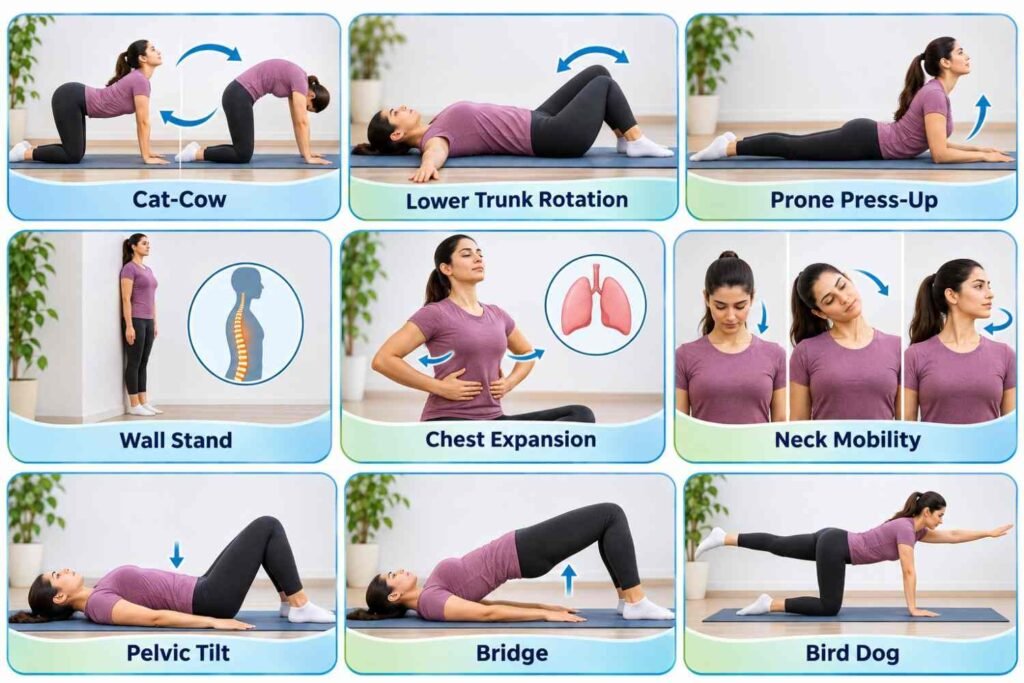
Do these once or twice a day, ideally after a warm shower rather than first thing when you are stiffest. Move slowly and breathe normally.
Back stretches for ankylosing spondylitis
- Cat-cow: On hands and knees, slowly round your back, then arch it. Do 10 slow reps.
- Lower trunk rotation: Lie on your back with knees bent. Lower both knees to one side, hold 5 seconds, then switch. Do 5 to 10 each side.
- Prone press-up: Lie face down, prop yourself on your forearms and gently lift your chest. Hold 15 to 30 seconds, repeat 2 to 4 times. It counters the stooped posture.
- Wall stand: Stand with heels, buttocks and shoulder blades against a wall, chin level. Hold 5 seconds, repeat 10 times. Repeat it every two weeks as a posture check.
Breathing and neck
- Chest expansion: Place your hands on your lower ribs, breathe in until your ribs push outward, hold for three counts, then breathe out slowly. Take five breaths, a few times a day.
- Neck mobility: Tuck your chin, tilt each ear toward its shoulder, then turn your head slowly. Do three each way.
Core and back strength
- Pelvic tilt: Lie on your back with knees bent and gently flatten your lower back into the floor. Hold for 5 seconds, 10 reps.
- Bridge: From the same position, lift your hips until shoulders, hips and knees form a line. Hold for 5 seconds, 8 to 10 reps.
- Bird dog: On all fours, lift one arm and the opposite leg while keeping your back flat. Hold 5 seconds, 5 on each side.
Ankylosing Spondylitis and Walking (What About Jogging?)
Walking is the easiest place to start. The SAA suggests aerobic activity three to five times a week, totalling roughly 75 to 150 minutes. Begin with 10 minutes, walk tall with your eyes level, and build gradually. When Ohio weather turns icy, use a treadmill, an indoor track or a pool instead.
Jogging with ankylosing spondylitis is a more personal call. High-impact running and jumping load the spine and hips, and many guides advise avoiding them, especially during flares or if you are new to exercise. If you ran before your diagnosis, ask your rheumatologist and physiotherapist before returning, and use these tips to prevent running injury.
Yoga for Lower Back Spondylitis and Other Low-Impact Options
Slow, supported movement suits AS well. Yoga for lower back spondylitis works best with gentle, held poses rather than forceful twists or deep backbends, particularly during a flare. Pilates, tai chi and water exercise are good options too. Cleveland Clinic rheumatologist Dr. Ahmed Elghawy says water work is gentle on the joints and you can progress to land exercises once it feels easy.
Your Weekly Plan
| Day | Plan | Time |
| Monday | Moves 1 to 6 | 15 min |
| Tuesday | Walk or swim | 30 min |
| Wednesday | Strength moves 7 to 9 plus stretches | 20 min |
| Thursday | Yoga, Pilates or tai chi | 30 min |
| Friday | Walk and wall stand check | 30 min |
| Saturday | Swim or easy cycling | 30 min |
| Sunday | Gentle stretches and rest | 10 min |
On a flare day, apply heat first, then keep to breathing and gentle movement within a comfortable range. Skip held strengthening and call your rheumatologist if the flare drags on.
What to Avoid
- Jumping, martial arts and contact sports.
- Heavy loads placed directly on the spine or shoulders, such as a barbell squat.
- Forcing deep twists or bends when you are stiff.
- Pushing through sharp pain. Mild soreness is normal, but sharp or worsening pain is a signal to stop and speak to your doctor, since it may mean a flare.
Ankylosing Spondylitis Physical Therapy: What a Physiotherapist Adds
Ankylosing spondylitis physical therapy goes beyond a handout. A physiotherapist checks your posture and spinal and chest mobility, builds a plan around your goals, corrects your technique and progresses you as you improve. Ankylosing spondylitis and physiotherapy work best alongside rheumatology care, and physical therapy for spondylitis is a long-term partnership more than a short course. Our exercise therapy follows this approach.
If you live in Ohio, the American Physical Therapy Association’s Find a PT directory lets you search for a licensed therapist. Look for one with AS experience and bring this plan to your first visit. If you are in Delhi, Dr. Roshan Jha and the team at our Dwarka clinic can build a personalised programme: book an appointment.
Frequently Asked Questions
What is the best exercise for ankylosing spondylitis?
There is no single best exercise. The strongest programmes combine spinal stretches, deep breathing, core strengthening and low-impact cardio such as walking or swimming. Pick activities you enjoy, because consistency matters more than intensity.
What exercises should you avoid with ankylosing spondylitis?
Avoid high-impact and contact activities such as jumping, contact sports and martial arts, heavy weight directly on the spine, and forced twisting. Stop any movement that causes sharp pain and check with your doctor.
Is walking good for ankylosing spondylitis?
Yes. Walking is low-impact and easy to build up. Work toward the SAA’s suggested 75 to 150 minutes of weekly aerobic activity, keep your posture tall, and switch to a treadmill or pool in bad weather.
How do you strengthen your back with ankylosing spondylitis?
Use gentle core and back exercises such as pelvic tilts, bridges and bird dogs two to four times a week, with slow, controlled reps.
Can exercise stop ankylosing spondylitis from getting worse?
Exercise cannot cure AS, but regular stretching and strengthening help maintain mobility and posture and lower the risk of joints stiffening. It works alongside, not instead of, your rheumatologist’s treatment plan.
The Bottom Line
The right ankylosing spondylitis exercises, done gently and often, keep your spine moving and your posture upright. Start with the nine moves above, follow the weekly plan, and have a physiotherapist check your technique. This guide is educational and not a substitute for medical advice.