




Best Rotator Cuff Exercises for a Damaged Shoulder: A Physiotherapist’s Guide
The best rotator cuff exercises for a damaged shoulder are gentle, pain-free movements done in phases. Start with pendulum swings and assisted arm raises to restore motion. Then add shoulder blade squeezes, isometric holds and resistance-band external rotation to rebuild strength. Keep pain at 3/10 or lower, and stop anything sharp.
Persistent shoulder pain that wakes you at night, or an arm that suddenly feels too weak to lift, is worrying. The good news is that many rotator cuff problems respond well to structured exercise. In over a decade of orthopaedic rehab, the most common mistake I see is jumping straight to strengthening. This guide shows the right order.
What Is a Damaged Rotator Cuff?
Your rotator cuff is four muscles and their tendons (supraspinatus, infraspinatus, teres minor and subscapularis). They hold the ball of your shoulder in its socket. Damage ranges from irritated tendons to a partial or full-thickness tear, and many cases are managed with non-surgical physiotherapy for torn shoulder tendons. Typical signs include pain when lifting the arm, pain lying on that side, weakness and clicking. Only a clinical exam or scan can confirm a tear.
The 3/10 Pain Rule
Rate your pain from 0 to 10. Mild discomfort up to 3/10 is acceptable if it settles within an hour. Stop if you feel sharp pain, catching, or if the shoulder is worse the next morning. Restore movement before strength. Rushing this order is what turns a manageable injury into a long one.
Phase 1: Calm and Move (Roughly Weeks 0–3)
- Pendulum swing: Lean on a table and let the sore arm hang. Gently sway forward and back, side to side, then in small circles. Do 1 minute, 3 times daily.
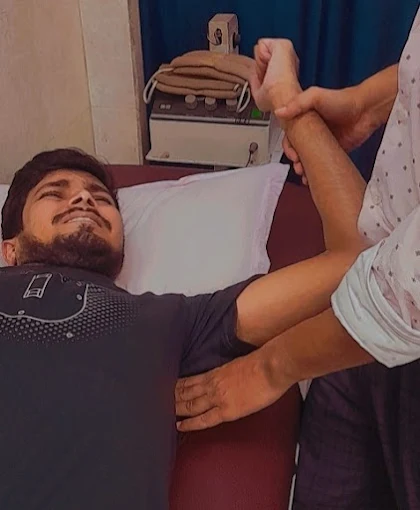
- Assisted arm raise: Lie on your back and hold the sore wrist with your other hand. Lift toward the ceiling and overhead only as far as comfortable. Do 8 reps, holding 5 seconds.
- Shoulder blade squeeze: Sit tall and squeeze your shoulder blades together as if holding a pencil. Do 10 reps, holding 5 seconds.
Phase 2: Rebuild Strength (Roughly Weeks 3-8)
- Isometric external rotation: Bend your elbow to 90° at your side. Press the back of your hand into a doorframe without moving. Do 5 holds for 10 seconds.
- Band external rotation: Tuck a rolled towel under your elbow. Rotate your forearm outward against a light band, returning slowly over 3 seconds. Do 2 sets of 10–12.
- Band row: Pull a band toward your waist and squeeze your shoulder blades. Do 2 sets of 12.
Phase 3: Return to Function (Roughly Week 8+)
- Scaption (thumbs-up raise): Raise your arm about 30° in front of the side plane, up to shoulder height only, with a very light weight.
- Wall slide: Rest your forearms on a wall and slide them upward slowly.
Progress only when the previous phase feels easy and pain-free. These timelines are a rough guide, because tear size, age and job demands change the plan. Throwers, swimmers and racket-sport players can then move on to a return-to-play plan for overhead athletes before going back to full training.
Exercises to Avoid With a Torn Rotator Cuff
- Overhead and military presses
- Push-ups, bench dips and wide-grip bench press
- Upright rows and behind-the-neck movements
- Heavy, jerky lifting, throwing sports and swimming until cleared
The common thread is load, overhead or end-range positions, and limited control. That combination can repeatedly pinch the tendon under the shoulder’s bony arch, so the tendon never gets a chance to settle.
Can Exercise Replace Surgery?
For many people, yes. Cleveland Clinic reports that about 8 in 10 people with partial tears improve with non-surgical treatment.
A Finnish study of 173 patients aged 55+ found that physiotherapy alone gave results similar to surgery for non-traumatic tears. Read how physiotherapy compares with surgery for degenerative shoulder tears in our detailed guide. Sudden traumatic tears, or full-thickness tears in young, active people, often need a surgical opinion.
When to See a Physiotherapist Straight Away
- Sudden weakness or inability to lift your arm after a fall
- Night pain disturbing sleep for more than two weeks
- Numbness, tingling or pain running down the arm
- No improvement after 2–4 weeks of gentle exercise
Get a Plan Built for Your Shoulder
A generic list cannot tell whether your problem is a tear, shoulder impingement or a neck-related issue. At Pain Free Physiotherapy in Dwarka, New Delhi, Dr. Roshan Jha assesses your movement, strength and history, then builds a step-by-step programme for your exact shoulder. You can book a hands-on shoulder assessment in Dwarka or call and WhatsApp us (Mon–Sat, 9 AM–2 PM and 3–9 PM).
FAQs
Q.1 What is the best exercise for a torn rotator cuff?
There is no single best exercise. Begin with pendulum swings and shoulder blade squeezes, then progress to band external rotation. The best exercise is one you can do with good form and without sharp pain.
Q.2 What exercises should be avoided with a torn rotator cuff?
Avoid overhead presses, push-ups, bench dips, upright rows and heavy or jerky lifting until a physiotherapist or doctor clears you.
Q.3 Can a torn rotator cuff heal on its own?
Small partial tears may settle, but a torn tendon rarely fully reattaches without surgery because of limited blood supply. Symptoms often improve with physiotherapy even if the tear remains.
Q.4 How long does a rotator cuff take to heal without surgery?
Minor tears often improve in 6–12 weeks. Larger tears can take several months.
Q.5 Should you exercise a torn rotator cuff?
Yes, gentle guided exercise usually helps, but avoid painful overhead and heavy work. Lower-body exercise like walking or cycling is generally safe.
Q.6 How do you strengthen a torn rotator cuff at home?
Once motion is restored, use light resistance bands for external rotation and rows 3 times a week, progressing slowly under physiotherapy guidance.
Q.7 Is it OK to do rotator cuff exercises every day?
Gentle motion exercises (Phase 1) can be daily. Strength work needs rest days so the tendon can recover.